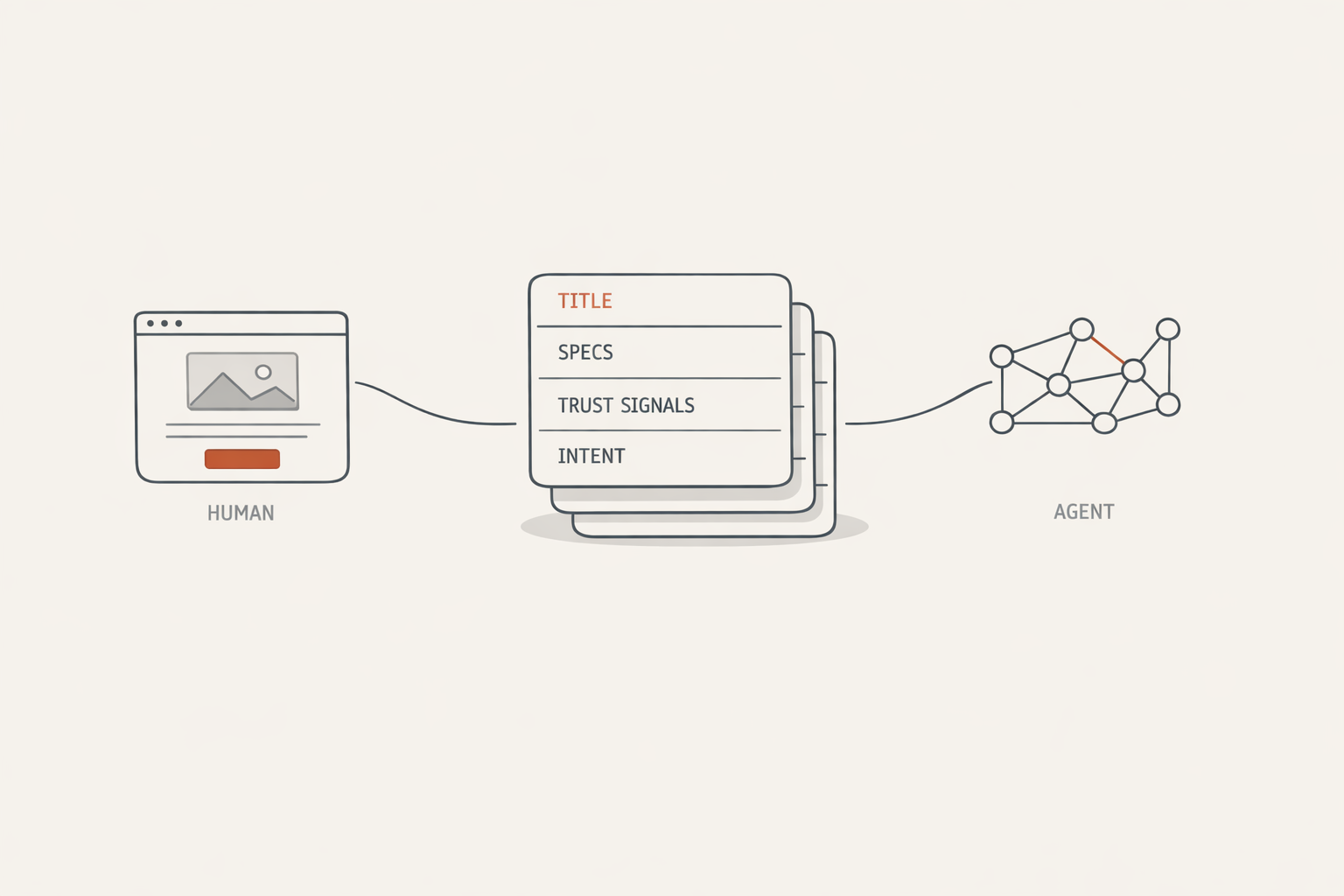
Last week I facilitated a panel called "What the agentic shift means for your website," with Neha Khawas (Principal Solutions Engineer, Contentful) and Brian Browning (VP Enterprise Solutions, APPLY). My job was to ask the questions, not answer them. Here's what I took away from 45 minutes of listening closely.
Why does this topic matter right now: well over half of Google searches already end without a click. The exact number shifts depending on which study and which month you check, because AI Overviews are still spreading and search engines keep tuning them, but the direction has been trending upwards for months. This is already reshaping who reaches your website and the knowledge they have on your brand, and this is just answer engines, not even agents.
The distinction that made everything else click
Most of the confusion around "agents" comes from mixing them up with the GenAI most people already use. The framing that held up for the whole conversation: GenAI is help me understand. Agentic is help me get it done.
An answer engine indexes what it knows and gives you an answer. Brian called it, half-joking, "a glorified search engine." An agent is different. It reasons over a goal, decides what tools and information it needs, and acts, sometimes coming back to ask a clarifying question along the way. That's also why it needs more governance, not less. The more autonomy something has, the more it can get wrong entirely on its own.
Two audiences, one content layer
Neha's core argument, and the one I keep coming back to: "your content layer is your context for agents." If your content isn't structured and modular enough to be queried and interpreted by a machine, it won't get recommended, it won't get acted on, and it won't show up for answer engines either.
The practical shift is thinking in two audiences instead of one. Humans still want the emotional, visual brand experience: the story, the design, the reason to trust you. Agents want something else entirely: accurate, structured, trustworthy information they can reason over. The same content, reused, can serve both.
What breaks is when it doesn't. Content gets duplicated or fragmented across systems that were each built to solve a different use case. That fragmentation isn't new. It's just that an agent has zero tolerance for it. It doesn't work harder to find the truth. It just fails quietly.
Neha's four pillars of agent-readiness
When Neha audits a customer's site "through the eyes of an agent," she's checking for four things:
- Intent and quality of content: is it accurate, and does the structure communicate what each page is actually for: a landing page versus a product page versus a support article?
- Personalization: if you've already invested in audience-segment personalization, extending it to agents is a shorter step than starting from zero.
- Localization: not just translation, but content that's genuinely discoverable market by market, since agents search with the same regional nuance humans do.
- Governance: trust and authority in your messaging, consistent across every channel an agent might pull from.
Five questions to ask your team tomorrow
The more actionable version of the same idea, and the one worth stealing directly:
- Can we name the trusted sources behind our top products or highest-performing marketing assets?
- Can that information move across channels and markets without being rewritten each time?
- Does it carry enough structure and metadata to be machine-readable?
- Do we know where AI is making changes on our behalf, with a human still in the loop?
- Can we measure which resulting experience actually worked, and turn that into a recommendation for the next campaign?
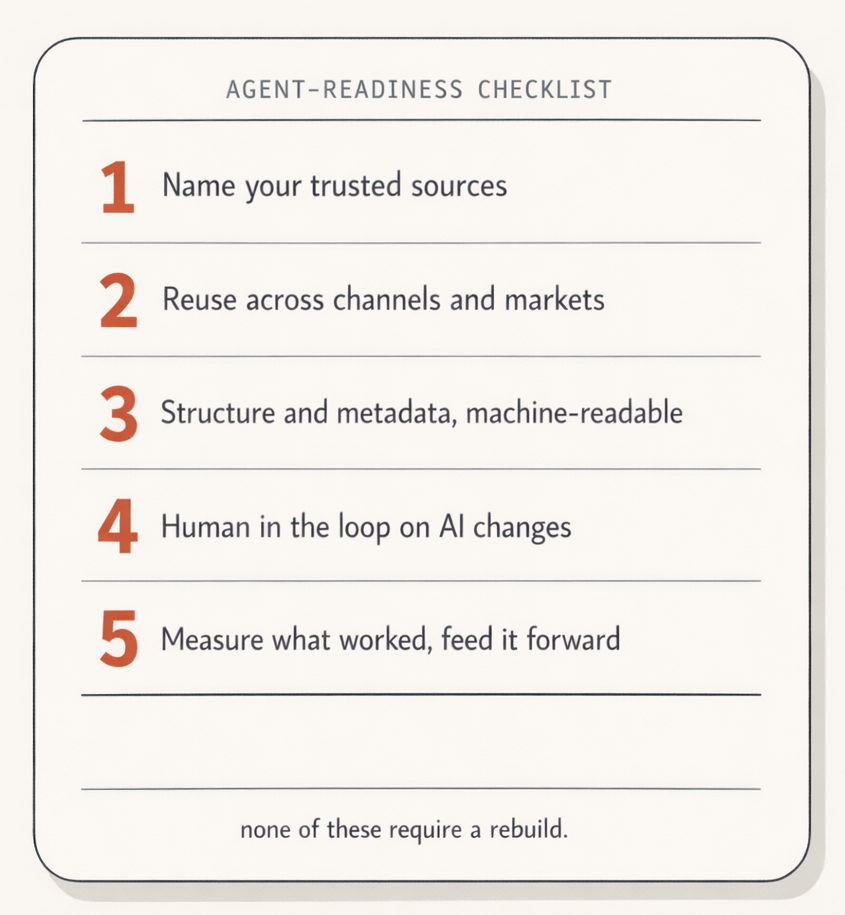
None of these require a rebuild. Most of them expose a problem that already existed. Agents don't just make it visible. They scale the problem.
Where to actually start
Brian's answer to "where do I start" was refreshingly narrow. Three steps, in order:
- Check whether you're composable. Do you have structured content at all? This is the prerequisite, not an optional nice-to-have.
- Cover the basic hygiene. An LLMS.txt file. Schema.org JSON-LD on your key page types. A robots.txt review. And it's worth investigating WebMCP, an emerging standard (a W3C proposal, not something any single vendor owns) that lets a site expose structured tools directly to an agent instead of forcing it to scrape and guess its way through a UI.
- Then get innovative. Revisit your customer journeys for where an agent could open genuinely new revenue or loyalty opportunities, not just efficiency gains.
Steps one and two are foundational and largely invisible to a human visitor. Step three is where it gets interesting, and where most organizations aren't looking yet.
What I'm taking into my own work
The audience poll landed almost exactly where I expected: split evenly between "just starting to figure it out" and "we've started experimenting with agents." Nobody voted "we're done." That's the honest state of the industry right now, and probably the honest state of most teams reading this.
The line I closed the panel with is the one I keep repeating to myself since: build for humans today, and then be ready for agents tomorrow. Not a rebuild. Not a rip-and-replace. A foundation you're laying anyway, that happens to be exactly what the next few years are going to need.
P.S. The full recording is available on demand: Contentful's Agentic Shift Website event page.
Enjoyed this? Read the extended cut on the Second Brain Stack Substack →